Envelope Deep Dive · The Bottom of the Box
Basement, Crawl Space & Slab Insulation In Depth
The bottom of a Maine house is where energy, moisture, and air quality problems intersect. Uninsulated concrete drains heat all winter; damp foundations feed the air the stack effect delivers upstairs. This page covers basement walls, rim joists, crawl spaces, and slabs — moisture first, insulation second, code throughout.
The physics below grade
Concrete is a heat sink, and the ground never warms up
Deep-ground temperature in Maine hovers around the low 50s°F year-round (roughly the annual mean air temperature — the ASHRAE Handbook of Fundamentals' ground heat-transfer chapter is the design source), while the top few feet of soil track the winter down toward freezing. Bare concrete has almost no thermal resistance — around R-1 for a full 8-inch wall — so an uninsulated foundation conducts heat outward all heating season, hardest at the above-grade and shallow sections where ΔT is biggest. A full basement can account for a fifth or more of a leaky home's heat loss, and it makes itself felt upstairs: the basement ceiling becomes a cold radiant surface under the first floor, and cold floors are the #1 comfort complaint in Maine houses (ASHRAE Standard 55 — the thermal comfort standard — treats cold surfaces and vertical air-temperature stratification as measurable comfort defects, not just perception; more on the standards page).
The bottom of the house is also the intake side of the stack effect: below the neutral pressure plane, the basement runs at negative pressure and pulls in outdoor air — plus soil gases and whatever the basement air carries — and sends it up through the living space. Sealing and insulating the foundation improves the air you breathe on the first floor, not just the fuel bill.
Rule zero
Moisture first: never insulate a wet basement
Concrete is a sponge — it wicks ground moisture by capillarity and passes vapor continuously. Insulation changes the temperature of surfaces and the drying behavior of the assembly, so the moisture picture must be handled before the foam goes up:
- Bulk water out: grading, gutters, downspout extensions, and where needed interior drainage and a sump. Liquid water problems disqualify a wall from insulation until solved.
- Vapor-tolerant materials only: below grade, that means rigid foam (EPS/XPS/polyiso as appropriate) or closed-cell spray foam directly against the concrete — assemblies that don't mind humidity and that keep interior air away from the cold concrete.
- No fiberglass against foundation walls, no interior poly: the classic 1980s studs-batts-and-poly basement wall traps condensation against cold concrete and grows mold. BPI's assessment practice (moisture inspection is a required element of BPI-1200-based audits) exists partly because of that generation of failures.
- Mind radon and combustion: tightening the basement changes house pressures — radon pathways and atmospherically vented appliances get re-checked after the work (CAZ testing per BPI practice).
Assembly by assembly
Basement walls, the rim joist, crawl spaces, and slabs
Basement walls — inside or outside the envelope?
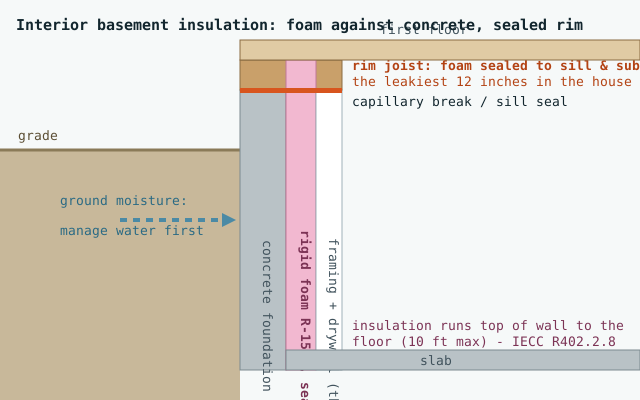
You have a choice of where the thermal boundary runs: insulate the foundation walls (basement becomes conditioned-ish space — best when mechanicals, ducts, or laundry live down there, which is most Maine homes) or insulate the basement ceiling to R-30 and treat the basement as outdoors (then every duct and pipe below needs its own protection). Wall insulation usually wins on cost, freeze protection, and comfort. The code numbers for Zone 6 (2021 IECC §R402.2.8 / Table R402.1.3): R-15 continuous, R-19 cavity, or R-13+R-5ci, from the top of the wall down 10 feet or to the floor. Finishing a basement into living space makes this mandatory — it's a change of space conditioning triggering full compliance (details here).
The rim joist — the leakiest twelve inches in the house
Where the floor framing sits on the foundation, wood meets concrete in a long, cracked, uninsulated band that is both a major conductive loss and a premier air leak at maximum stack suction. The fix — closed-cell spray foam or cut-and-sealed rigid board in every bay, sealed at sill and subfloor — is inexpensive, invisible, and included in virtually every professional weatherization scope.
Crawl spaces — seal them, don't vent them
The modern, code-recognized approach in our climate is the unvented, conditioned crawl space: heavy ground vapor barrier sealed up the walls, wall insulation at the basement-wall levels (IECC §R402.2.10), vents closed, and the space either supplied with a little conditioned air or exhausted per the IRC (§R408.3). Open crawl vents in Maine import humid summer air onto cold surfaces and arctic winter air under your floors — the old advice made both problems worse.
Slabs
For new work, slab-edge insulation is code: R-10 extending 4 feet down/under/out, plus R-5 under the full slab when it's heated (IECC §R402.2.9). The slab edge is the detail to fight for in any addition or garage-conversion project — it's unreachable later, and an uninsulated edge in Zone 6 is a permanent cold ring around the room.
Code corner — foundations
Basement walls R-15ci / R-19 / R-13+5ci to 10 ft or the floor (§R402.2.8); crawl space walls likewise with sealed ground cover (§R402.2.10; IRC §R408.3); slab edge R-10 × 4 ft, heated slabs +R-5 (§R402.2.9); foam plastics protected per IRC §R316; finishing a basement = full compliance for the newly conditioned space (§R501.1.1 → §R502). Basement, crawl, and rim work are all rebate-eligible weatherization under Efficiency Maine.
Cold floors? Musty basement? Same fix.
A proper job assesses moisture first, then foams the walls and rim to code — turning the coldest, dampest part of the house into part of the envelope. Our recommended installers work exactly this way.
Assess My Basement