The Standards Behind the Work
BPI & ASHRAE, Explained for Homeowners
Two organizations sit behind nearly every claim on this website and every specification in a quality insulation job: the Building Performance Institute, which sets the standards for how existing homes are assessed and improved, and ASHRAE, whose standards and handbooks supply the underlying engineering — comfort, ventilation, and the physics of heat itself. Here's who they are and what their standards mean for your house.
Organization one
Building Performance Institute (BPI): the home performance standard-setter
bpi.org · ANSI-accredited standards developer & certifying body
What BPI is
BPI develops the national technical standards for assessing and retrofitting existing homes, and certifies the professionals who do it (Building Analyst, Envelope Professional, and related designations). Its standards are ANSI-accredited — developed through the same consensus process as other American National Standards — and they form the technical backbone of weatherization programs across the country, including the assessment and installation practices behind Efficiency Maine's residential programs.
The standards you'll encounter
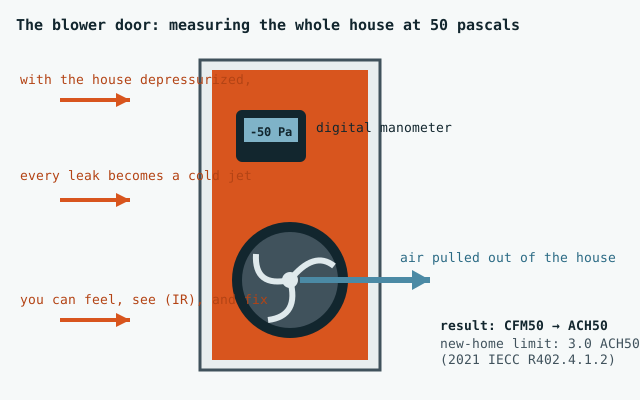
- ANSI/BPI-1200-S-2017, Standard Practice for Basic Analysis of Buildings — the home-assessment standard: blower door airtightness measurement, combustion appliance zone (CAZ) safety testing, moisture inspection, and ventilation evaluation against ASHRAE 62.2. When we "test in" and "test out," this is the playbook.
- ANSI/BPI-1100-T-2014, Home Energy Auditing Standard — defines the comprehensive home energy audit: what must be inspected, measured, and reported for a complete picture of a house.
- BPI's house-as-a-system doctrine — the principle running through all of it: envelope, mechanicals, moisture, and occupants interact, so every measure is checked for its effects on the others. Tighten the envelope → verify combustion safety and ventilation. Insulate the basement → check moisture and radon pathways. It's the difference between installing product and improving a building.
What it means for you
Hiring to BPI standards buys you measurement instead of assertion: a leakage number before and after, documented combustion safety, ventilation brought to standard, and installation details (density, coverage, alignment with the air barrier) that determine whether rated R-value becomes real R-value. It's the practice to demand from any installer — our recommended installers work to it — and it's also what Efficiency Maine's Registered Vendor specifications are built around.
Organization two
ASHRAE: the engineering society behind the numbers
ashrae.org · American Society of Heating, Refrigerating and Air-Conditioning Engineers · founded 1894
What ASHRAE is
ASHRAE is the global engineering society for the built environment's thermal and air systems. Its handbooks and ANSI-accredited standards are the source documents that building codes cite — including Maine's: MUBEC directly adopts three ASHRAE standards (62.1, 62.2, and 90.1, 2019 editions), and the R-value and heat-loss math throughout this site traces to the ASHRAE Handbook of Fundamentals.
The four ASHRAE touchstones for a Maine homeowner
- Handbook of Fundamentals — the reference for how heat, air, and moisture move through buildings: conduction (Q = U×A×ΔT), material R-values, ground temperatures under your foundation, infiltration physics including the stack effect, and psychrometrics (why humid air matters). When we size an insulation package or estimate savings, this is the physics underneath.
- ANSI/ASHRAE Standard 62.2 — Ventilation and Acceptable Indoor Air Quality in Residential Buildings — the "ventilate right" half of build-tight-ventilate-right, adopted in MUBEC. It sets whole-dwelling mechanical ventilation rates (a formula based on floor area and bedroom count, on the order of dozens of CFM continuous for a typical home) plus local exhaust for kitchens and baths. A properly air-sealed house gets its fresh air by design — filtered, right-sized, and continuous — instead of by accident through the rim joist.
- ANSI/ASHRAE Standard 55 — Thermal Environmental Conditions for Human Occupancy — the comfort standard. Its central insight for insulation customers: comfort is governed by operative temperature — roughly the average of air temperature and the mean radiant temperature of surrounding surfaces — plus drafts, humidity, stratification, and floor temperature. Cold windows, uninsulated walls, and cold floors make a 68°F room feel like 62°F; insulation warms the surfaces, which is why insulated homes feel comfortable at lower thermostat settings. That "comfort dividend" is real, measurable, and part of the payback.
- ANSI/ASHRAE Standard 90.1 / 90.2 — Energy standards — 90.1 (commercial and larger residential, adopted in MUBEC alongside the IECC) and 90.2 (dwellings) are ASHRAE's energy-efficiency standards; the IECC that governs your house evolved in dialogue with them. Same engineering lineage, different rulebook covers.
How it fits together
Standards → code → program → your house
The chain of custody for a good Maine insulation job looks like this: ASHRAE supplies the physics and the ventilation/comfort standards → the ICC codes (IECC/IRC) turn them into enforceable minimums, which MUBEC adopts for Maine — directly incorporating ASHRAE 62.1, 62.2, and 90.1 → BPI standards define how existing homes are measured and improved to (and beyond) those minimums → Efficiency Maine pays rebates when the work follows program specifications built on that same foundation → and a contractor working to all of the above hands you a tighter, warmer, healthier, documented house.
When a contractor's proposal cites none of this — no blower door, no ventilation plan, no combustion safety check, no installed-R documentation — you're buying bags of material, not building performance. The standards are your consumer protection; use them.
Hire the standards, not just the truck
Our recommended installers follow BPI assessment practice, meet ASHRAE 62.2 ventilation, and land inside MUBEC — with the documentation to prove all three.
Get a Standards-Grade Assessment