Envelope Deep Dive · Interior Boundaries
Insulating Between Heating & Cooling Zones
Not every wall in your house separates inside from outside — some separate 68°F from 50°F, or a heat-pumped bedroom from an unheated spare wing. Every one of those temperature boundaries is a miniature thermal envelope, and treating it like one is how zoned heating actually saves money. This page covers interior walls and floors between zones, partially conditioned spaces, and the comfort science behind it.
The principle
A zone boundary only saves energy if it can hold a temperature difference
Zoning — heating or cooling different parts of the house to different temperatures — is one of the biggest behavioral savings available in a Maine home: the physics of setbacks is simple, since heat loss scales with the inside-outside temperature difference (Q = U×A×ΔT, per the ASHRAE Handbook of Fundamentals), so a wing held at 55°F instead of 68°F loses meaningfully less heat all winter. Heat pumps, mini-split heads, and smart thermostats have made zoning the default in renovated Maine homes.
But here's the catch: an ordinary interior wall has almost no thermal resistance — two layers of drywall and an empty cavity amount to roughly R-3, and interior partitions are built with zero air sealing (open plates, back-to-back outlets, undercut doors). Put a 13-degree difference across that wall and heat pours from the warm zone into the cold one; your "setback" savings quietly become a subsidy paid by the heated zone's heat pump, working harder against a boundary that can't hold. The cold zone also drags down comfort in the warm one: the shared wall and floor become cold radiant surfaces, and ASHRAE Standard 55 — the thermal comfort standard — is explicit that comfort depends on mean radiant temperature, not just air temperature. A 68°F room bounded by 55°F surfaces feels like the low 60s, which is why people bump thermostats and erase the savings.
The rule, then: wherever you intend a sustained temperature difference, build a real boundary — insulation appropriate to the ΔT, air sealing, and a weatherstripped door. The bigger and more permanent the difference, the closer the boundary should get to exterior-envelope quality.
The cases, graded by ΔT
Which interior boundaries to insulate, and how much
| Boundary | Typical ΔT | Treatment |
|---|---|---|
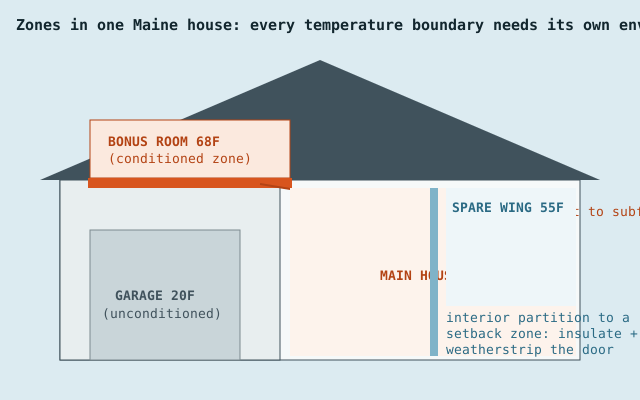
| Living space ↔ unconditioned garage, porch, shed (walls and floors above) | 40–70°F | This is the thermal envelope: code R-values (wall options, floor R-30, Zone 6), full air sealing, garage separation per IRC §R302. Bonus rooms over garages fail here constantly — insulation hanging below the subfloor instead of in contact with it (IECC §R402.2.7) leaves a cold air blanket under the floor. |
| Living space ↔ seasonally closed-off wing or ell | 15–40°F | Near-envelope treatment: dense-packed partition, sealed plates and penetrations, insulated/weatherstripped door. Protect plumbing in the cold zone — freeze protection sets the floor on how low the cold side may go. |
| Heated house ↔ setback zones (guest rooms at 55–60°F, thermostat-scheduled floors) | 8–15°F | Fill the shared partitions and the floor/ceiling between zones (cellulose or mineral wool), seal the boundary, solid-core gasketed doors. Modest cost; this is what makes multi-head heat pump zoning deliver its promised savings — and it doubles as STC 36–39 sound separation. |
| Room-to-room within one zone | 0–5°F | No thermal case — insulate for sound if desired. Don't let anyone sell you "energy" insulation between two rooms on the same thermostat. |
Duct and hydronic distribution crossing a cold zone needs its own insulation (ducts outside the envelope: R-8/R-6 per IECC §R403.3.1; hot water piping R-3 per §R403.5.3). A supply duct feeding the warm zone but leaking into the cold one defeats the whole arrangement — duct sealing is part of any zoning scope.
Pressure balance: the part everyone forgets
Zone boundaries change airflows. Close a tight door on a room with a supply register and no return path and the room pressurizes, driving its air into wall cavities and outdoors while the rest of the house depressurizes and sucks in replacement air — BPI's diagnostic toolkit includes zonal pressure testing for exactly this reason, and it's how an installer verifies a zoning plan won't backfire. Transfer grilles, jump ducts, or door undercuts sized to the airflow keep zones neutral. And in the tightened, zoned house, whole-dwelling ventilation still has to meet ASHRAE 62.2 — fresh air is planned per the standard's rates for the whole home, not left to leakage through the cold wing.
Setbacks without regrets
Three practical guardrails for cold-holding zones in Maine: keep any space with plumbing above ~50°F (or drain it); keep the cold zone's humidity in check so its cold surfaces don't condense (a sealed boundary helps by keeping warm moist air out); and give the boundary door the same respect as an exterior one — the best-insulated partition in Maine loses to a door left ajar.
Zoning your house with heat pumps?
Our recommended installers build the boundaries that make zoning pay: dense-packed partitions, sealed floors between zones, insulated ducts, and pressure-tested results — scoped together with your envelope work.
Plan My Zone Boundaries